
A review of the indie game by SoulMuppet Publishing.
My friends know I’ve been kicking around an idea for several years for a TTRPG that not only kicks ass, but also teaches community organizing and revolution. I’ve been calling it Grab a Brick, cause bricks are good for breaking stuff and for building things. (I often think I am clever, and am just as often proven wrong.) I was 1 degree of separation from surprise pitching Grab a Brick to Tom Morello in the hallway at GaryCon three years ago. Unfortunately, that degree was COVID, which hit me like a bag of bricks the day before. So I was not present when my friends ran into Mr. Rage Against the Machine himself. C’est la vie, eh?
Well, I am excited to say that I may have found a game that will make me stop thinking about my half-baked idea. (Unless you are reading this, Tom. If so, call me!) I picked up Mad as Hell at GenCon this year on a lark, and boy-howdy, am I glad I did!
Mad as Hell is really Rad(ical)
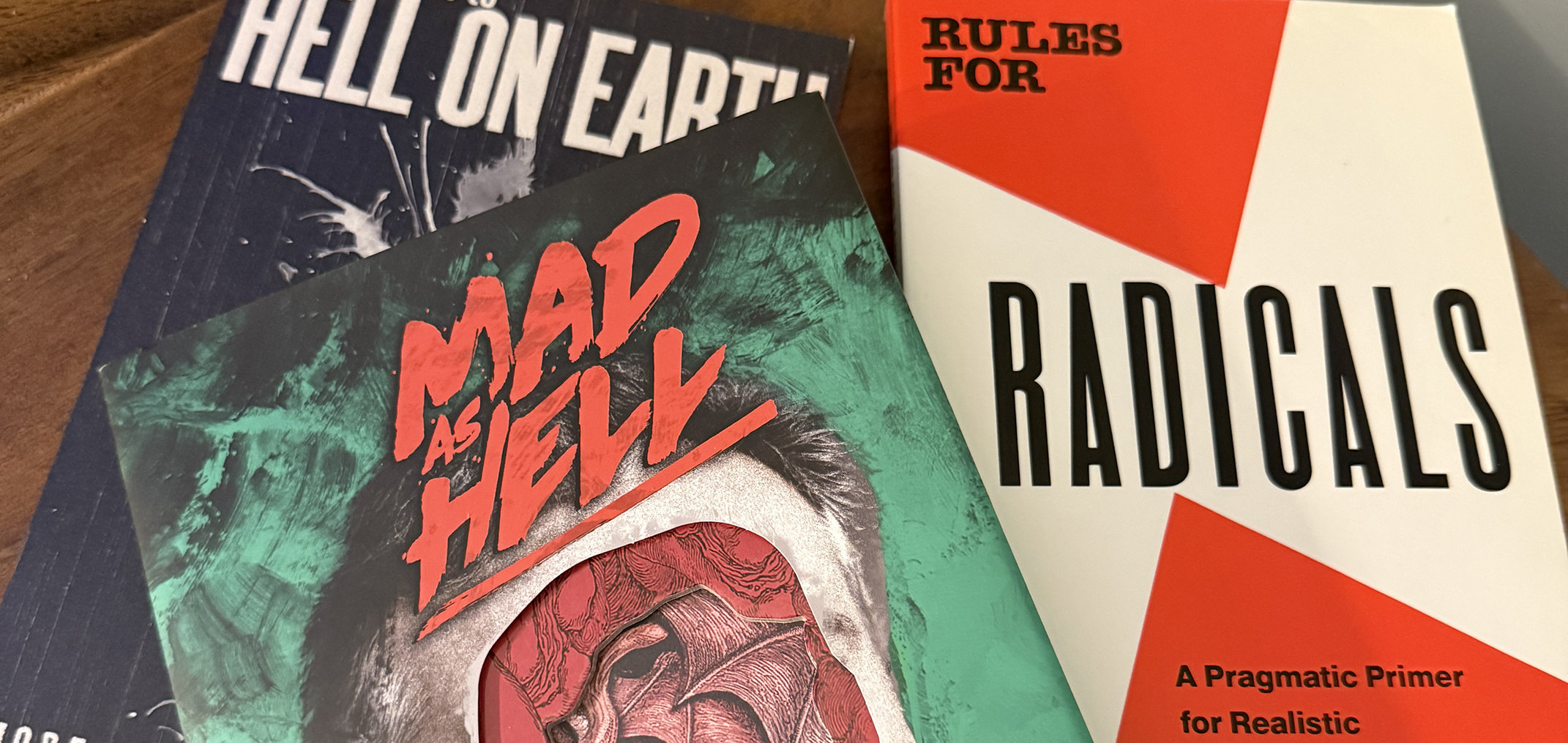
I keep a copy of Rules for Radicals by the inimitable Saul Alinsky on my desk at all times. Admittedly, I haven’t opened it in, well, a long time… but Mad as Hell has me itching to do so again!
So, what’s it about?
As you no doubt guessed by now, the game is about being a radical in a world full of capitalist pig-dogs and fascist turds. Here’s the twist–the capitalists and fascists are sometimes literal demons! And your radical gets to fight them while building and strengthening your community. They don’t call it “an anti-capitalist demon-hunting roleplaying game of resistance, community, and punching evil” for nothing!
The system
The game is pretty simple. Characters have three stats: Solidarity, Conspiracy, and Militancy, which are all self-explanatory in terms of when to use them. Players roll 2D6 and add the relevant stat, which will be rated from +0 to +2 at the beginning. Success occurs on a 9 or higher.
There is also a trait called Exertion that, in most cases, can be used to improve chances of success. There is also Distress, which is a measure of how tired, stressed, and downtrodden a character is. The higher Distress gets, the more risk there is of them Getting Hurt, which is real physical harm (Wounds).
Those are the basics. Where it gets interesting is in how characters relate to the world around them.
Characters are members of one or more Communities, which they can access for benefits like resources and information. Doing so can reduce the community’s strength and/or introduce the community to greater risk. So interacting with the community gives the characters strength while endangering the communities, which is my favorite concept in the game.
Additionally, characters can have Privileges they can use as much as they want, but they also have downsides. These include things like a doctor friend (who lives inconveniently far away) or disposable income (that is linked ot ilicit activity).
There are a few other odds and ends, but this covers the best parts.
Cool as hell!
The main Mad as Hell TTRPG book is gorgeous. It embraces being an indie title, so it doesn’t feel over-produced or flashy. At the same time, the artwork is evocative, the layout is engaging and fairly readable (minus the tiny font), and the use of color is fantastic. The cover is the highlight, of course, with its three layers that pull you into the horror of demonic middle-aged men in suits.
Perhaps the coolest thing in Mad as Hell is all of the creativity that went into designing the demons. I can only imagine the fever dreams that the designers embarked on to come up with some of them. The core book has a handful of really fun baseline ideas for demons. It’s mostly the stuff you think of when you think of being a wage-slave in a capitalist cesspool: vice, contamination, brutal enforcers. But when you dive into The Field Guide to Hell on Earth, a demon supplement, you get a lot more nuance and horror. One of my favorites is the Memory Hole, which spawns and grows when old harms are ignored and fade into the status quo. It thrives on being internalized and ignored by the community… it hits hard.
Upon reflection
Yeah, this is a game about the evils of a world that is startlingly similar to our own. But it is more than that. In fact, it is better than that. It is also a reflection and an abstraction of what happens when communities organize, resist, and fight. And that makes it a powerful reminder of the good in the world, starting with the good in our communities.